Conversation needs product truth.
The assistant must understand open-ended intent while keeping recommendations anchored to approved attributes, availability and commercial rules. Unsupported answers fall back instead of becoming product advice.
03 / Independent AI reference architecture
A personal, client-neutral reference architecture for combining conversational guidance with trustworthy product context. It is not presented as commissioned by, deployed for or representative of any employer or client.
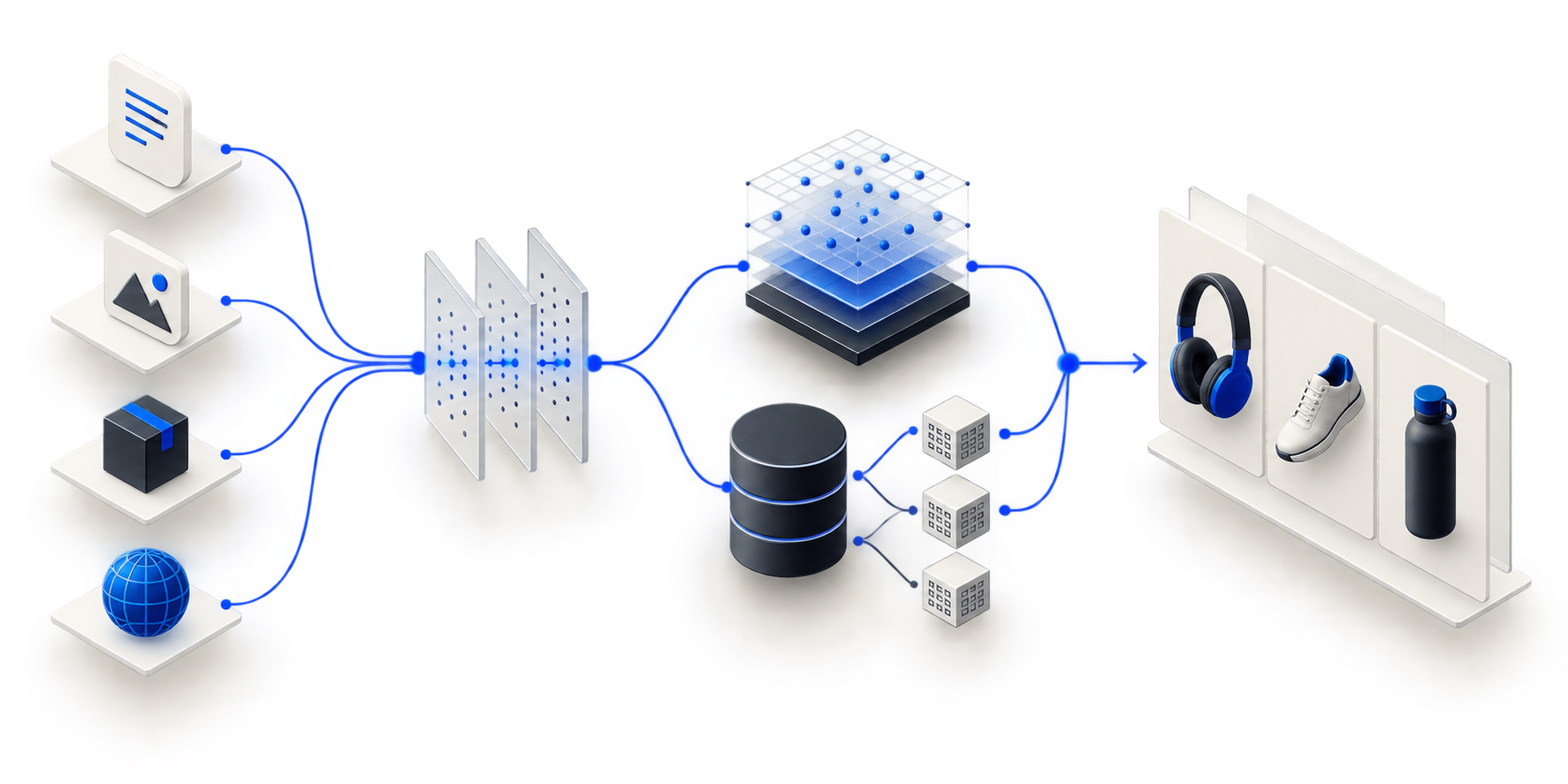
The assistant must understand open-ended intent while keeping recommendations anchored to approved attributes, availability and commercial rules. Unsupported answers fall back instead of becoming product advice.
FastAPI defines the service boundary while LangGraph coordinates intent classification, retrieval, bounded tool execution and response synthesis. Bedrock-hosted models use semantic search together with structured catalogue queries.
A golden test set and RAGAS-style measures cover faithfulness, relevance and retrieval quality. Citations, traces, guardrails and low-confidence fallbacks keep behaviour reviewable and human-led.
Text architecture
Technical answers
It turns open-ended product questions into grounded guidance by combining conversational intent with approved catalogue attributes, availability and commercial rules. When evidence is insufficient, the assistant explains the limitation or falls back safely.
LangGraph models the interaction as explicit states and transitions for intent classification, retrieval, bounded tool use, synthesis and review. That structure makes execution traceable and prevents an agent from skipping required checks.
Semantic retrieval handles meaning and discovery; structured queries preserve precision for attributes, availability and rules. Hybrid retrieval keeps the experience conversational without treating generated language as product truth.
A golden test set and RAGAS-style measures track faithfulness, relevance and retrieval quality. Citations, tool boundaries, traces and low-confidence fallbacks keep responses reviewable and human-led.
Primary technical references
My scope
Continue